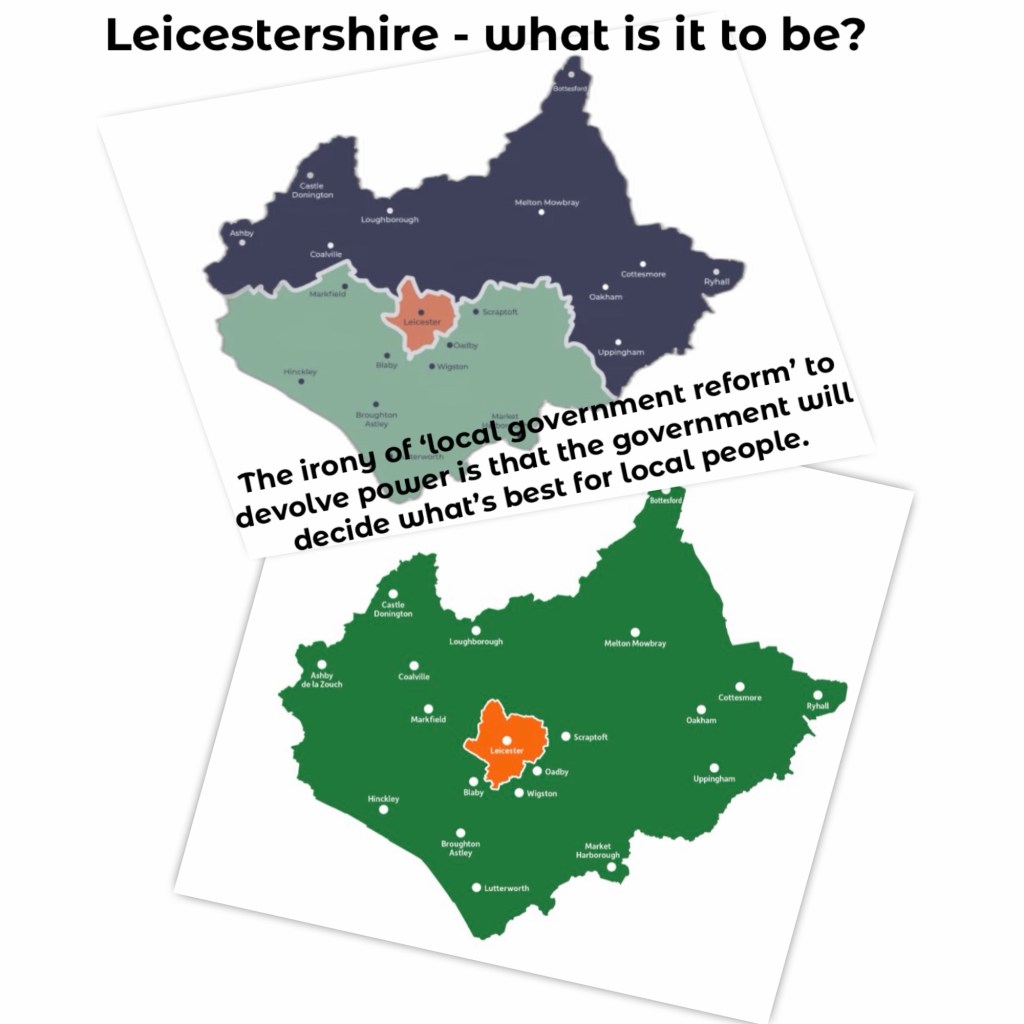
Local Government Reorganisation (LGR) is being driven from the centre with a clear preference for fewer councils and larger authorities. The stated aims are “devolution” and “efficiency”.
I’m not instinctively opposed to change — I’ve spent a career delivering complex transformation — but you don’t start by rearranging structures and hope the outcomes improve later. You start by being clear about the problem you’re trying to solve, then you design the operating model around residents’ needs. You also use that change as an opportunity to transform what you do, a paradigm shift in process and operations, not more of the same repackaged – that’s failure.
At the moment, that logic feels thin. So it’s worth asking plainly: what, exactly, is LGR meant to fix in Leicestershire?
The problem residents actually experience isn’t the number of councils.
Most people don’t lie awake worrying about tiers of government. They contact councillors because something has gone wrong and they want it put right.
Typical examples include: repeated flooding or drainage failures unsafe roads, speeding, congestion and pinch points planning conditions ignored, or mitigation arriving years late estates built before the supporting infrastructure shows up developer contributions mentioned, but hard to track in practice
Behind nearly every one of those issues sits the same practical question:
Who is responsible, and who can actually fix it?
Too often, the answer is unclear. Responsibility is split across tiers, agencies, contractors and developers. Residents end up being passed from one organisation to another, or told something is “with a partner”. People lose confidence not because they dislike local government in principle, but because they can’t see clear ownership and a reliable route to resolution.
So the first test for any reorganisation should be simple: will it make accountability clearer to residents, or will it create even more distance and buck-passing?
Leicestershire is not starting from scratch: most major services already operate at county scale.
This is an important local reality that gets glossed over in national commentary. In a two-tier county, the biggest, most complex, highest-risk services are already delivered at county footprint: adult social care, children’s services (including SEND pressures), highways and transport, waste disposal, and more. Whether you like the current structure or not, that scale exists for a reason: resilience, specialist capability, and consistency.
Which leads to a second test for LGR in Leicestershire:
What do we gain by disrupting county-scale delivery capability — and what do we risk?
If a model increases duplication or destabilises care services, children’s services or highways delivery, it fails the public interest test before you even get to the finer detail.
Planning is where trust is being lost — and the current public interfaces makes it worse.
Planning is one of the sharpest points of friction locally, not because residents hate all development, but because they often experience growth as something imposed while infrastructure lags behind. Often it is perceived as a done deal or the consultation process isn’t genuine: HMP Welland Oaks (Gartree2).
And even when residents want to engage constructively, the system makes it unnecessarily hard. Consultation is routinely channelled through clunky, internet-based planning portals that are poorly structured and difficult to navigate. Key information is buried in long lists of attachments, documents are labelled in ways only professionals understand, and residents are expected to decode technical drawings and jargon without support.
In practice, the tools often turn people away rather than encourage early, informed conversation. That is not a minor irritant — it’s one of the reasons consultation becomes polarised. If you want better decisions, you need better participation, and that starts with making planning information genuinely accessible.
The “North / City / South” option: why it’s not the answer
If you talk about One County, someone will immediately respond with “North / City / South” as the supposedly more “local” alternative. It sounds superficially attractive: split the county into two rural unitaries (north and south) and leave Leicester City as it is.
The problem is operational. That model achieves “local” by splitting county services, then recreating duplicated capacity in two new organisations. The predictable consequences are:
1) Duplication rather than efficiency
Two rural unitaries means two senior leadership teams, two commissioning functions, two sets of corporate systems, two approaches to contract management and performance. You don’t get leaner by building two versions of the same machinery.
2) Higher transition complexity and cost
Splitting a county is harder than merging districts. You are dividing staff, assets, contracts, liabilities and IT platforms that currently operate across one footprint. While that work is being done, services still have to run. Residents don’t get to pause their needs during “transition”.
3) Increased risk where it matters most
Adult social care and children’s services are already under intense pressure nationally. Fragmenting strategic delivery capability risks instability, inconsistency, and loss of resilience — exactly the opposite of what residents need.
And there’s a final irony: when you fragment strategic services, you often end up creating new joint arrangements to coordinate what doesn’t fit neatly inside borders — transport integration, cross-boundary growth, infrastructure planning. That’s how a model sold as “simpler” ends up generating more boards, more meetings, and more blurred lines of responsibility.
So if the aim is clear accountability and stronger delivery, North/City/South is a high-risk route to duplication and complexity.
If LGR is happening, we should shape it so it keeps Leicestershire local.
I don’t think the right response is simply to shout “no” and hope Westminster changes its mind. If the government is determined to proceed, we should focus on designing the outcome around what residents actually want: clear accountability decisions taken as close to communities as possible strategic services protected from fragmentation local voice strengthened with real levers, not token consultation.
This is why the broad direction of the One County approach can align with what I am arguing for — but only if “local” is hardwired into the operating model.
A single strategic unitary can preserve county-scale capability for the big services. The obvious risk is remoteness. That risk is manageable if you design strong local governance underneath it — not as a gesture, but as part of how the council works day-to-day.
Keeping it local: what One County must include
If we are going to make good out of bad, these are the practical components that must be in the model.
1) Area-based governance with delegated powers and delegated budgets
Not area committees that simply “discuss”. Area governance that can decide local priorities, allocate funding, and commission small place-based improvements. Delegated budgets for local highways priorities, community safety and environmental maintenance, with published work programmes and transparent reporting.
2) Local planning committees — and visible enforcement ownership
If planning is to be local, it can’t stop at the decision notice. It must include enforcement and delivery. Residents need confidence that conditions are monitored, breaches are acted upon, and mitigation is delivered when promised.
3) Planning made accessible: resident-first information, not a document dump
This is the part that could genuinely transform engagement if we’re willing to apply fresh thinking.
Replace the “attachment warehouse” experience with a clear summary page for each application: what is proposed, what changes on the ground, what the claimed impacts are, what infrastructure is promised, and what the key policy considerations are.
Publish simple, legally sound templates for resident representations so people can structure comments around material planning considerations (highways, flooding, design, ecology, heritage, noise, air quality, housing mix). People shouldn’t be deterred because they fear saying the “wrong thing”.
Standardise the way core information is published so it can be processed consistently. Right now it’s often PDF soup. If key elements are structured (numbers, access points, drainage approach, biodiversity net gain position, draft conditions, S106 heads of terms, triggers and milestones), then modern tools — including AI — can generate plain-English summaries for residents and consistent briefings for decision-makers.
That doesn’t replace judgement; it makes the evidence digestible so judgement can be exercised properly.
Track delivery openly: conditions, S106/CIL obligations, triggers, receipts and spend. Trust collapses when the public can’t see whether what was promised is being delivered.
4) Empowered town and parish councils — with support, not just responsibility
Town and parish councils are the closest democratic bodies to residents. They can do more on local place issues, but only if there is proper resourcing, training and support. Devolving responsibilities without funding is not empowerment; it’s passing the problem down the chain.
5) A single front door and named accountability
This is the change residents will actually feel. Any new system should provide one place to report an issue, a named accountable owner, a clear escalation route, and a time-bound response standard. The public shouldn’t need to understand internal structures to get a pothole, flooding issue, enforcement breach or safety concern addressed.
Conclusion: make the reform earn its keep
If Labour wants LGR to be credible, it has to show — in operational terms — how this will improve delivery and accountability in places like Leicestershire, not just how it tidies a map.
For Leicestershire, the sensible approach is to protect strategic county-scale services from fragmentation, reject options that duplicate structures and increase risk, and use the opportunity to strengthen local decision-making through delegated area governance and a more capable, better-supported town/parish tier.
Most importantly, we should modernise the planning experience so it invites participation rather than discourages it. If residents can understand proposals, comment in a structured way, and track delivery commitments afterwards, we will get better decisions and rebuild trust.
That is what “keeping it local” should mean in practice: clear ownership, accessible processes, and real local influence over the decisions that shape the places people call home.
If you want better services, keep scale (One County). If you want power closer to people, you don’t need fragmentation—you need delegated local decision rights and budgets – which if built properly with local democratic accountability in mind points to a One County model.


 On The Page
Leave a comment