The question is not simply whether, but how and when—and crucially, what it could cost.
The process has already begun: consultation, followed by a non-binding referendum, and then a decision by Full Council on whether to proceed. No outcome has been determined. That makes it important that the discussion is grounded in clear, balanced information.
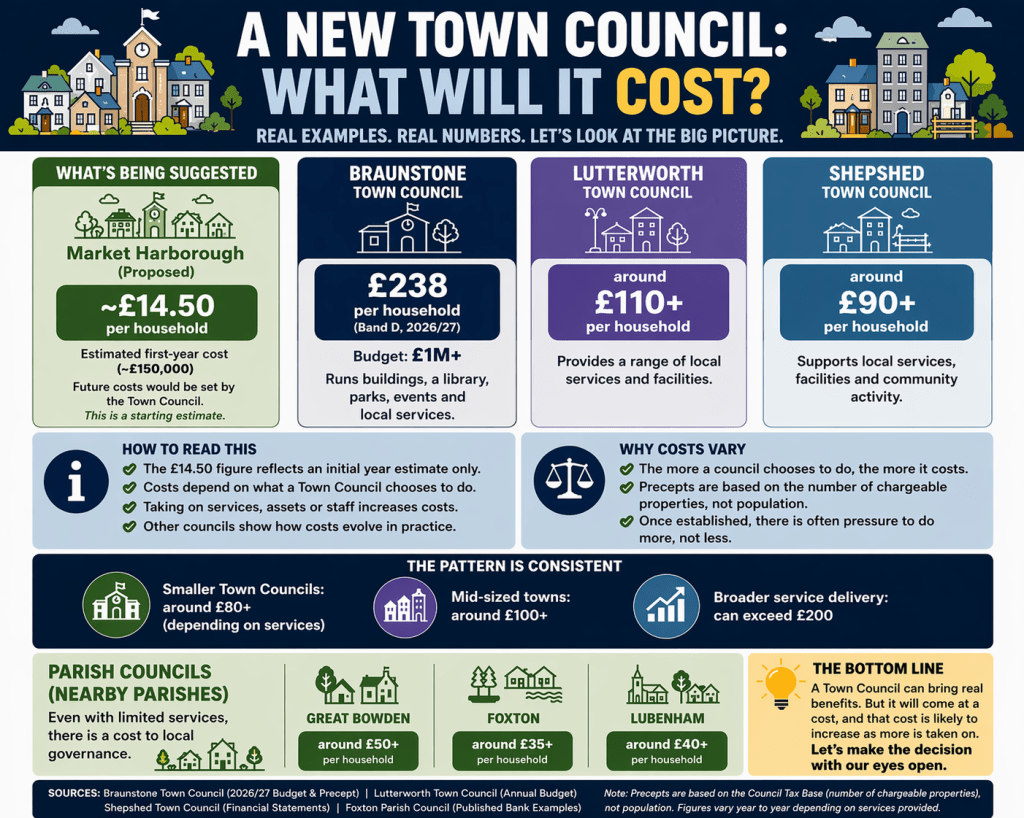
A headline figure of around £14.50 per household is being suggested. That is based on an initial first-year estimate of around £150,000. It is not a mature budget, a long-term projection, or a reflection of delivering a full range of services. It is a starting point. Future costs would be set by the Town Council itself.
So the issue is not whether £14.50 is achievable in year one—it may be—but how costs could evolve over time, depending on what the council chooses to do.
Looking at existing councils helps provide context. Braunstone Town Council runs buildings, a library, parks, events and local services. It has a budget of over £1 million and costs £238 per household (Band D, 2026/27). That is simply what delivering a broad range of services looks like in practice. Elsewhere, Lutterworth is around £110+ per household and Shepshed around £90+. These figures vary year to year, but the pattern is consistent: the level of service provided drives the cost.
Closer to home, even parish councils providing relatively limited services still carry a cost. In villages such as Foxton, Lubenham and Great Bowden, there is a local precept—around £35+, £40+ and £50+ per household respectively. That is the baseline. Even providing a limited range of services and activities still carries a cost.
If a Town Council were to be created, its future cost would depend on the decisions it makes. Over time, there is likely to be consideration of taking on assets, improving facilities, supporting community activity, and employing staff to deliver services. These are common features of Town Councils. Each, however, has a financial implication. As responsibilities increase, costs tend to increase.
There is also a practical point on timing. Local government is already managing significant pressures—day-to-day services, the Local Plan, and the wider implications of Local Government Reform. Teams are working hard, but capacity is not unlimited, nor are services always operating at a full complement of staff. Introducing a new Town Council structure adds further work and coordination at a demanding time.
I have no doubt officers will do their best, as they always do. The question is whether it is fair—or sensible—to add further complexity at this point. For me, that is a matter of timing and practicality, not principle. Good ideas still need the right moment.
There will be those who argue that this is the only opportunity—that once Local Government Reform progresses, it may be harder to establish a Town Council. I understand that view, but I do not necessarily share it. Reform will change structures, but it does not remove the need for local representation. If anything, it may strengthen the case in future, once the system is clearer and settled.
So the question is not simply whether this can be done now, but whether it should be done now. Acting now is one option. Acting at the right time is another.
It is also sometimes suggested that a Town Council would be “non-political”. In the sense of formal party labels, that may be the intention. But it is important to be clear about what that means in practice.
Local issues—planning, development, services and priorities—are inherently matters of judgement. People will bring their own perspectives and values to those decisions, and those perspectives will differ. Some of the strongest voices in this debate already hold clear and well-defined views on a range of local and national issues. That is part of public life, and it is entirely legitimate.
So while a Town Council may not operate on a party political basis, it would not be free of politics altogether. It would simply be politics expressed without formal party labels. That places a greater responsibility on voters and those who claim to be ‘independent’ or non-partisan. Without party labels, it becomes more important to understand where individuals stand, what they prioritise, and how they are likely to approach decisions.
Removing party labels does not remove political viewpoints—it simply makes them less obvious. That makes honesty and disclosure all the more important.
This is not about being for or against a Town Council. I support the principle. It is about ensuring that residents have a clear and realistic understanding of both the potential benefits and the potential costs. A starting estimate is useful, but it is only part of the picture.
In summary:
- The £14.50 figure is an initial estimate, not a long-term position
- Costs depend on what a Town Council chooses to do
- Real examples show how costs vary
- Even smaller councils carry a baseline cost
None of this predetermines the outcome. It does help ensure the discussion is informed.
A Town Council could bring real benefits—stronger local accountability, improved services, and a clearer voice for the town. But any future model involves choices about services, ambition and cost. The current consultation, referendum and Council decision provide the opportunity to consider those choices carefully.
Everyone needs to engage in this process openly, honestly, and with a clear understanding of the implications.
Have your say:
The consultation is still open.
If you have a view—whether in support, opposed, or somewhere in between—it is important that it is heard.
Via the HDC website – https://www.harborough.gov.uk/cgr25
You can also respond by email: CGR@harborough.gov.uk
Or in writing to: CGR Consultation, Elections Team, The Symington Building, Adam & Eve Street, Market Harborough, LE16 7AG
The consultation deadline is 13 April 2026, will be followed by a non-binding local poll on 30 April 2026, and then consideration by Full Council.
Sources
Braunstone Town Council – Budget & Precept (Band D £238.01, 2026/27)
Lutterworth Town Council – Annual budgets and precept reports
Shepshed Town Council – Financial statements
Foxton Parish Council – Published Band D examples (~£35–£42 recent years)
Note: Parish and Town Council precepts are based on the Council Tax Base (number of chargeable properties), not population. Figures vary year to year depending on services provided.


 On The Page
Leave a comment