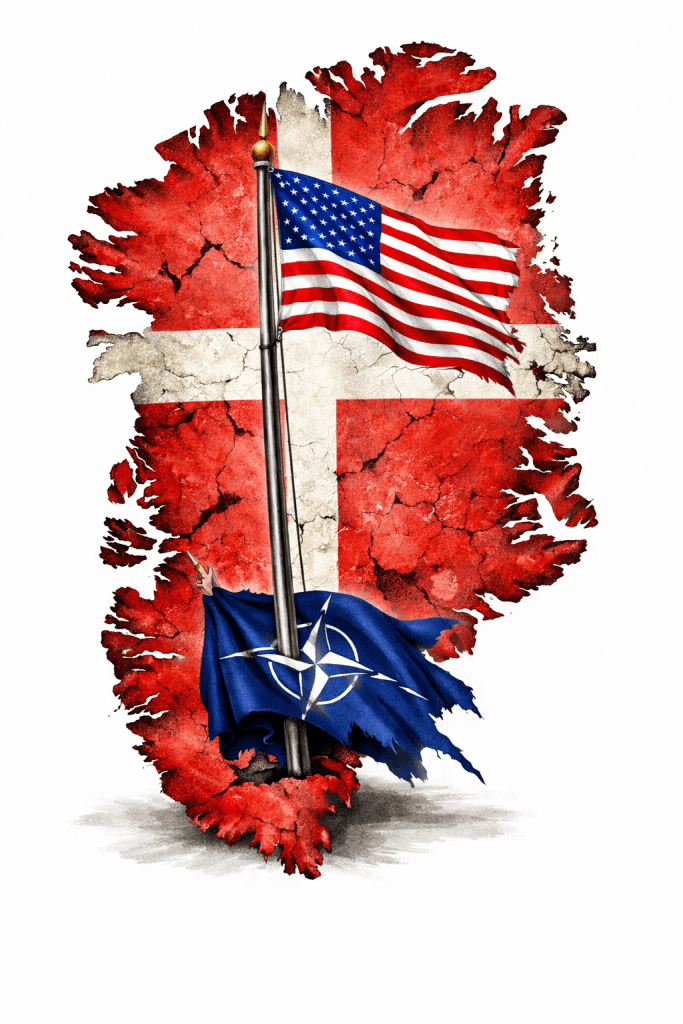
I understand the United States wanting to protect its national interest. I support it. A strong America has been the anchor of peace in Europe for generations, and the truth is that many of us have grown far too comfortable living under that umbrella.
America’s commitment to NATO is not abstract. It was born out of the blood spilt on European soil and has been measured since the Second World War in bases, personnel, intelligence, logistics, nuclear deterrence, and the industrial depth that makes all of those credible. It is measured in sustained investment over decades, and in a willingness to take global responsibility even when the domestic political rewards are thin. The stability we take for granted in Europe did not happen by accident. It was built, and America paid a very large share of the bill.
That is precisely why the current posture towards Denmark and Greenland is so frustrating. If the US wants to increase its military presence in Greenland, there is a sensible, respectful way to do it. Ask an ally. Negotiate a stronger footprint through NATO and bilateral defence channels. Agree the purpose, scale, rules, and cost-sharing, and get on with it. That is how serious alliances work, and it is how you secure long-term access that survives elections and changes of government.
What I cannot support is the strong-arm approach. It treats allies as if they are assets to be acquired rather than partners to be respected. It undermines the very alliance system that has served America so well. It also hands adversaries an easy narrative. If Washington is seen to bully allies, Russia and China will claim it proves that sovereignty and borders are merely preferences enforced by power. That is a dangerous precedent in a world already straining under pressure in Ukraine and around Taiwan.
There is another hard truth here. Europe has helped create the conditions for this kind of American impatience. For years, too many European governments have treated defence as a discretionary spend and national security as something handled by America. They have talked about values while outsourcing the means to defend them. They have preferred announcements to stockpiles, process to procurement, and moral posing to deterrence.
This is what freeloading looks like in the real world. It is not simply that Europe spends too little. It is that European capability is too often shallow, slow to mobilise, and dependent on American enablers. When the United States provides strategic lift, intelligence, missile defence, surveillance, and the serious warfighting depth that turns NATO from a club into an alliance, European leaders should not be surprised when America starts asking a blunt question. What exactly are you bringing to the table besides speeches.
The answer to that question has been too weak for too long. It is why Trump can look at Europe and see a continent that talks endlessly, hesitates constantly, and then expects America to absorb the cost and risk. It is also why he can conclude that respect is optional. That is not an excuse for his approach, but it is an explanation, and Europe would be foolish to ignore it.
Britain needs to look in the mirror as well. We still have professionalism, talent, and serious people in uniform. But we have let mass and readiness erode. We often behave like a country trying to project global influence on a diet of good intentions and shrinking capacity. You cannot secure sea lanes, deter hostile states, and reassure allies on reputation alone. Capability is what counts, and capability costs.
This is where Starmer is a problem, not a solution. He approaches the world like a legal technician in a moment that demands political judgement, strategic nerve, and hard choices. This is not a world of tidy black-and-white. It is leverage, risk, and deterrence. It is also a world in which European leaders who are timid and managerial will be ignored. Trump does not respect weakness. Putin exploits it. Xi counts on it.
So the argument is not anti-American. That would be childish and self-defeating. The argument is that Europe must finally stand up NATO in a way that protects America as well as Europe. Because if Europe remains strategically lazy, America will either disengage or start throwing its weight around inside the alliance. Both outcomes are bad for us, and both are bad for Washington.
If Europe wants America’s respect, it must earn it. That means spending properly, building industrial capacity, improving readiness, and fielding forces that can deploy and sustain operations without constantly leaning on American lift, intelligence, and munitions. It means doing less talking and more purchasing, training, and producing. It also means being honest with voters that security is not free, and it never was.
At the same time, America should pursue its Arctic interests through alliance discipline rather than coercion. The Arctic matters. Greenland matters. Russia and China certainly think so. The right response is a stronger NATO posture in the High North, agreed with allies, anchored in capability, and executed with seriousness.
Stand up NATO and you protect Europe. You also protect America. Because the United States should not have to carry the burden alone, and it should not be tempted into treating allies as bargaining chips. Europe’s job now is to stop freeloading, stop posturing, and start acting like a partner that deserves respect.


 On The Page
Leave a comment